
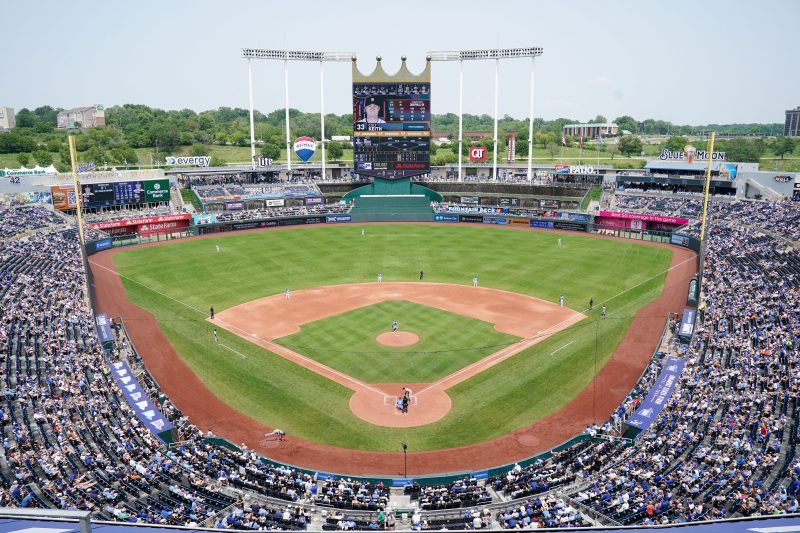
From their glory years in the 1980s, through their World Series championship in 2015 and even their surprise playoff appearance in 2024, the Kansas City Royals’ club identity fit hand-in-glove alongside the dimensions at Kauffman Stadium, their home ballpark.
Deep outfield fences, speedy, often elite defensive players to run down balls in the gap and swipe bases on the other side of the ball became imbued in the Royals’ identity – for better and worse.
Now, the club is aiming to take the power back.
The Royals announced Tuesday, Jan. 13, that they will move in the fences at Kauffman Stadium for the 2026 season, a ballpark modification that should dovetail with their burgeoning collection of young bats.
The fences in left and right field will be moved in nine to 10 feet, and the wall lowered from 10 feet to 8 1/2 feet in most locations. It’s not that Kauffman was a hitter’s graveyard in 2025; the K was among 15 ballparks that ranked between 99 and 101 on Statcast’s park factors, with 100 being neutral for both pitchers and hitters.
But it was particularly penal for home runs: Only San Francisco and Pittsburgh ranked lower than Kauffman’s 85 rating for longballs. Those extra few feet should make a difference for perennial MVP candidate Bobby Witt Jr., slugger Vinnie Pasquantino and rookie Jac Caglianone, who struggled in a 62-game audition yet still has more raw power than almost any prospect in the game.
Kauffman Stadium: What are the new outfield dimensions?
Dimensions released by the team indicate that the left- and right-field corners are each moving nine feet closer, from 356 and 353 feet to 347 and 344 feet. Left and right field move from 373 to 364 feet, while the alleys move in 10 feet, from 389 to 379 feet.
Dead center field remains 410 feet.
Who most benefits from the move?
It’s not hard to imagine Witt – who hit 30, 32 and 23 homers his first three full seasons – flourishing even more in this new environment. According to Statcast data, at least four of his doubles and triples in 2025 – all of which would’ve been homers in a majority of big league parks – would have been home runs in the 2026 configuration. Witt turns 26 in June, and only figures to be coming into his peak power years.
The Royals as a team finished 26th in home runs, hitting 56% of their home runs – 89 of 159 – on the road.
Which ballparks have significantly changed their dimensions?
Power costs money, and so does elite starting pitching. And altering the ballpark configuration is one way for teams outside the highest revenue realm to maximize their roster or organizational ethos.
The Detroit Tigers moved their center field fence in by 10 feet in 2023 – and promptly went from 52 homers at Comerica Park to 78 (Oh, there were many other factors, but that didn’t hurt).
At Camden Yards, the Baltimore Orioles took the opposite tack, famously moving the fence in left field back significantly in 2022, drawing pained expressions from their own right-handed hitters to scathing reviews from opponents such as Aaron Judge.
In 2024, they found a reasonable middle spot – and added elite right-handed slugger Pete Alonso this winter.
And in 2013, the San Diego Padres and Seattle Mariners both moved their fences in, with a Padres executive claiming a less pitcher-friendly Petco Park would result in baseball fans seeing ‘the game the way it’s meant to be played.’