
Evaluating NHL draft prospects at the world juniors is always an interesting process.
You’re watching players who are 17 or just recently turned 18 years old play up against the top under-20 talent in the world. It’s also a two-week tournament, which means there’s a small sample for what we are actually evaluating.
Whether it should be or shouldn’t be, NHL scouts value this tournament and other high-pressure events like the Under-18 World Championship quite highly. They look at how these players perform in high-leverage situations. They are looking to answer questions about the player.
Can they show up when it matters? Do they keep doing the small things when they are winning or losing a lopsided game? Are they able to elevate their game when they are playing the best competition?
Scouts inevitably make judgments on NHL draft-eligible prospects, so let’s look at how the stock for some of the top players changed at the World Junior Championship.
Stock up: Ivar Stenberg, LW, Sweden
In arguably his worst game of the tournament, Stenberg scored the game-winning goal in Sweden’s tournament-opening victory over Slovakia.
Then it was Stenberg, in one of his best games of the world juniors, who scored the empty-netter to seal the gold medal in the final.
Throughout this tournament, Stenberg got better and began to take over shifts and then periods and in the semifinal and gold medal game, he took over the game at times.
Finishing with 10 points in seven games was impressive, good for fifth in scoring, but it was everything else that Stenberg did that bumps his stock up. His defensive intensity, excellent puck-carrying ability in transition and intelligent forechecking were all major factors throughout this event.
When Sweden needed someone to answer the bell, Stenberg was right there to do so. By the end of the tournament, he was arguably one of the best players on the gold medal-winning squad.
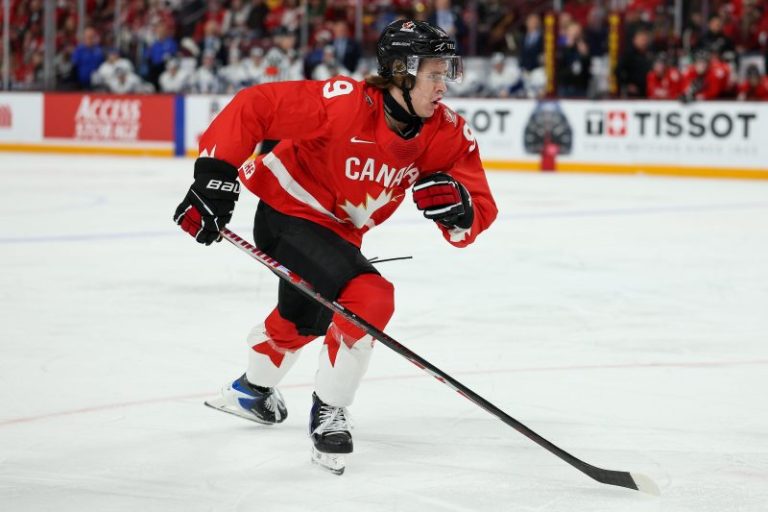
Stock down: Gavin McKenna, LW, Canada
It’s hard to say McKenna’s stock is down when he was second in tournament scoring with 14 points, and he helped Canada to a bronze medal. The reason that his stock is down is that his game was on full display with all of the eyes fixated on him at the highest level, and although his offensive game was evident, his play away from the puck left many questioning his ability to be the potential generational talent that he was once deemed to be.
McKenna is a stud. His puckhandling and vision are elite among the elite. He sees the ice in a way very few players do. He exploits the opposing team’s small defensive mistakes with his passing.
He’s an unreal offensive talent, but when you’re a player looked at as a potential first overall franchise-altering player, NHL teams want a more complete game.
Stock up: Viggo Bjorck, C, Sweden
The unsung hero of Sweden, Bjorck, took on a massive role for the Swedes, playing down the middle on the second line when Anton Frondell and Eric Nilson moved to the wing.
The undersized forward has been viewed as too small or unable to play a pro-style game, but between the way he’s adapted in the Swedish League against men in Sweden and the two-way prowess that he displayed at the world juniors, Bjorck’s name should be moving up NHL draft boards.
Bjorck has been an offensive juggernaut at every level as an underage player. He destroyed Sweden’s U-18 level and then proceeded to annihilate the U-20 level, setting the single-season scoring record at both levels as a 15 and 16-year-old.
Now at 17, he’s added a great deal of strength, defensive acumen and a work ethic that has overcome any issues scouts felt his size would impact.
Bjorck ended the world juniors with a gold medal around his neck while getting plenty of talk about whether he should have been on the tournament all-star team.
Stock down: Adam Novotny, RW, Czechia
It wasn’t that Novotny had a bad tournament. But on a team where everyone seemed to make a big impact, Novotny wasn’t really a factor for much of the tournament.
He had two assists against Denmark and one against Canada in the semifinal. Only one of his assists, one of the two against Denmark, was primary. Novotny just seemed like he wasn’t getting bounces all tournament long.
His speed wasn’t nearly as big a factor as expected coming into this tournament, and he wasn’t really comfortable being the primary puck carrier through the middle of the ice, one of his strengths.
Novotny ended up leading the tournament in shots on goal but didn’t have a single goal to show for it. Many of his shots came from distance, and he wasn’t getting to the middle of the ice much. A very weird, ineffective tournament for Novotny.
Stock up: Alberts Smits, D, Latvia
Hands down, Alberts Smits was Latvia’s best player at the World Junior Championship.
There is a reason we will see him featured on the men’s team at the Olympics next month. Smits showed he has everything you could want in a defenseman. He has size, mobility and the ability to play effective hockey at both ends of the ice. Smits was a big reason Latvia pushed Canada to overtime in their round-robin game.
Smits flexed his offensive chops as the tournament went on, adding five points in his last three games. Smits showed himself to be a defensively steady presence on the back end whenever the Latvians needed him to be, playing over 24 minutes a night.
All in all, Smits might be the closest thing to a Moritz Seider-level prospect that we’ve seen since the big German.
Stock steady: Oliver Suvanto, C, Finland
It was a bit of a head scratcher for some that Suvanto was named one of Finalnd’s best three players. He ended up with just two goals at the tournament, but it must be noted that the coaches vote on the top three players for each team, and coaches are suckers for a guy who does the little things right.
Suvanto was a constant defensive presence for the Finns. He was a constant force in shutting down the opposition, using his size and strength to lean on puck carriers.
The Finnish center was always in the right position in both zones. He wasn’t able to get on the scoresheet often, but the 17-year-old pivot was a big reason the Finns were able to play their typical structured game, earning them a trip to the bronze medal game.
Stock up: Tomas Chrenko, C, Slovakia
Chrenko isn’t a perfect player by any means, but for much of this tournament, he led the way in goals and points.
He is a bit on the smaller side, but he plays with pace, works hard to get the puck back, and he’s got some really nice finishing ability. Playing alongside his club teammate Adam Nemec, they both had a very solid tournament as draft eligibles.
The Slovak team couldn’t keep up against the top-end teams, but Chrenko gave them a very solid counterpunch. His speed allowed him to put pressure on defenders in transition. When they were in the attacking zone, Chrenko was buzzing around the zone looking to get open.
Even though his team was eliminated in the quarters, Chrenko finished second in goal-scoring at the WJC.
Stock steady: Chase Reid, D, USA
This was an interesting tournament for Reid. He’s the perfect example of why small samples shouldn’t be taken too seriously.
He was excellent early in the tournament, particularly against the lower-end teams, such as Germany or Slovakia.
But when the competition increased in difficulty, his impact fell off. He had a few notable turnovers against Sweden and Finland, looked a bit overwhelmed in his own end and showed his youth more often than not.
The positives were really great. He was pinching and activating, looking to be the player who dictates play. The lows were worrisome, though. All of that culminates to the opinion that Reid was fine overall. Anyone who got too high early or too low late needs to remember that this was a five-game sample and nothing more.
Stock steady: Carson Carels, D, Canada
It was a bit of a surprise when Carels was added to Canada’s training camp roster, but not only did he make the team, he started the tournament in the top six over fellow draft-eligible prospect Keaton Verhoeff.
Carels was fine throughout the tournament, but he was often playing in a reduced role and was eventually healthy scratched for a couple of games. He looked his best when paired with Verhoeff, but both draft-eligible defenders had some ups and downs.
Carels will get the boost from just having made this team, but his on-ice results brought some of the hype back down to reality. He is a 17-year-old defender on a team that wasn’t particularly strong in its own end.
Carels looked like a player worthy of a first-round pick, but the top-10 hype at the start of the world juniors may have been a bit premature.
Stock up: Tomas Galvas, D, Czechia
It’s very rare that an overage prospect is included here, but the tournament that Galvas just had justifies his inclusion.
Galvas was arguably the most effective two-way defenseman at this tournament. He was deservedly named to the tournament all-star team, the only undrafted player in the group. His mobility is elite, and he uses it at both ends of the ice.
Galvas is a small defenseman who plays sound defensive hockey because of how he reads plays and cuts opponents off.
His offensive skill is incredibly fun to watch, firing passes through traffic and generating chances all over the zone.
Galvas getting drafted as a 19-year-old is gaining more steam. An NHL club is going to try to find a way to get this kind of person in their organization, somehow or another. He’s been too good not to at least take a late-round flyer.
For action-packed issues, access to the entire magazine archive and a free issue, subscribe to The Hockey News at THN.com/free. Get the latest news and trending stories by subscribing to our newsletter here. And share your thoughts by commenting below the article on THN.com or creating your own post in our community forum.